


Grilled Picanha: Crispy Fat Cap, Wood-Fired
How to grill picanha (top sirloin cap) the Brazilian way: cut with the grain, salt only, render the fat cap first, sear hard and slice thin. Plus why picanha is...


Corten and stainless steel are the two most popular materials for fire pits and fire pit grills, and they age in opposite ways. Corten is a weathering steel: it rusts on the surface into a stable, rust-colored patina that protects the steel underneath. Stainless steel resists rust with an invisible chromium-oxide film and keeps its bright metal look. Arteflame builds grills in both, so this guide covers the differences that matter when you choose: looks, how the finish changes, staining, climate, care and price.
Corten is a family of low-alloy steels, widely known by U.S. Steel's COR-TEN name and covered by standards such as ASTM A588 and A606. Small amounts of copper, chromium, nickel and phosphorus change how the steel rusts. At first it rusts like ordinary steel. Then, as it goes through cycles of getting wet and drying out, the rust forms a dense, tight layer that slows further corrosion. That layer is the patina.
The patina is why Corten needs no paint. It keeps developing for months to years, and the color deepens over time. On Arteflame grills it builds over the first one to three years, from orange-tan to a dark brown. Every grill ends up a little different, depending on the weather where it lives. Read the chemistry behind Corten steel.
Stainless steel contains at least about 10.5% chromium, which forms a thin, invisible oxide film on the surface. If the film is scratched, it re-forms. The common grades outdoors are 304, often called 18/8 for its chromium and nickel content, and 316, which adds 2–3% molybdenum for better resistance to salt and chlorides. Stainless keeps its bright metal look, although the heat of a fire will tint it golden or blue near the flames.
| Corten (weathering) steel | Stainless steel | |
|---|---|---|
| Look | Warm rust-brown, changes and deepens with age | Bright metal that stays the same; heat tint near the fire |
| How it resists corrosion | A protective rust patina that forms outdoors | An invisible chromium-oxide film |
| Staining | New Corten sheds rust-colored runoff that can stain light stone, concrete or wood | No rust runoff |
| Best climates | Places where it gets wet and then dries; not ideal right on the coast or where it stays wet | Anywhere; grade 316 is best near salt water |
| Care | Keep it free of standing water and piled leaves; no sealing needed | An occasional wipe-down to prevent water spots |
| Price | Lower | Higher |
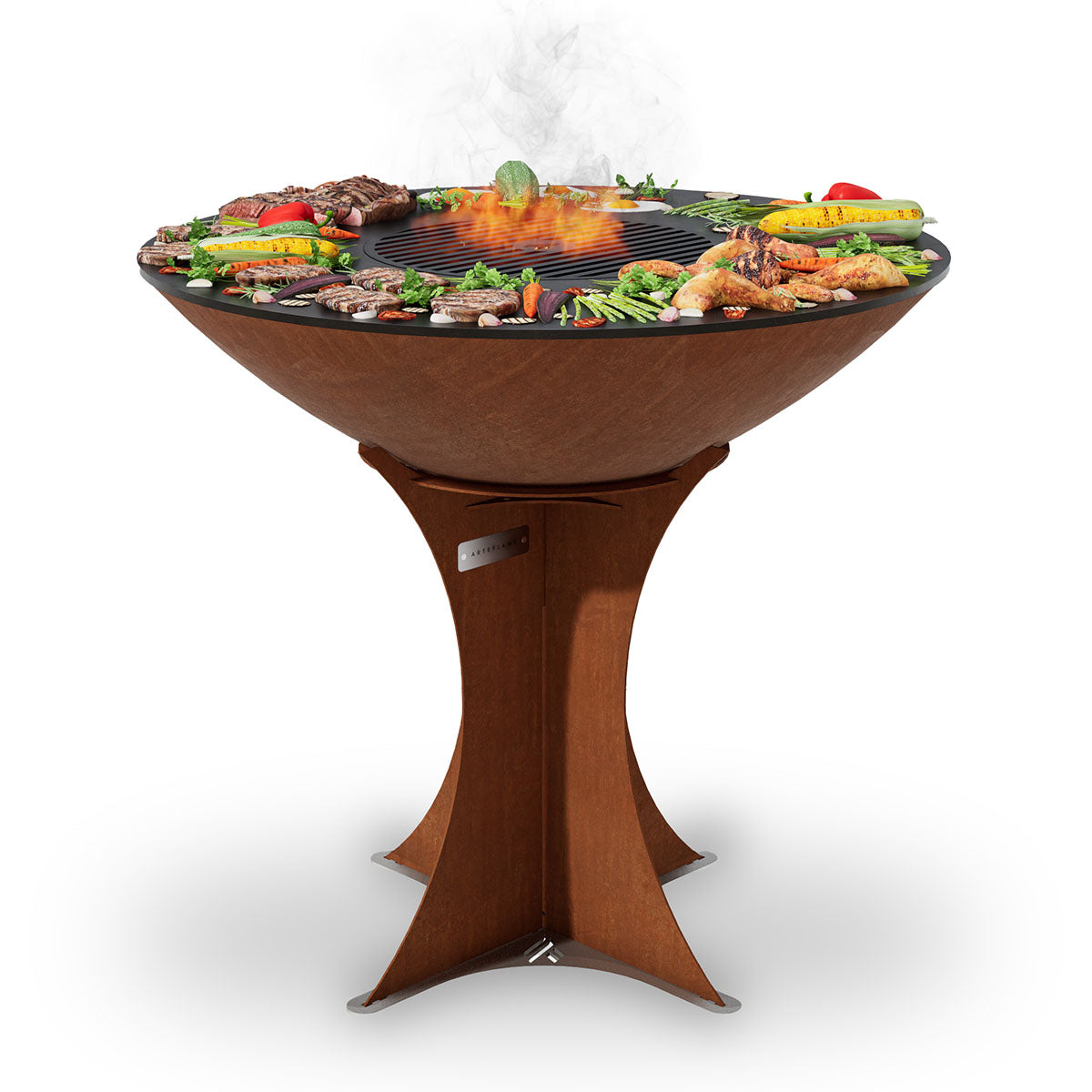
While the patina is forming, rain washes some rust off the surface. The U.S. Federal Highway Administration notes that this runoff stains concrete. On a light stone patio, wood deck or pale pavers, plan for it: set the grill on gravel, dark stone, or a pad you do not mind marking. Arteflame grills stand on stainless steel footers or screw-in feet to limit contact with the surface, but runoff can still reach the ground around them. Once the patina is stable, runoff drops off a lot.
Corten needs to dry out between wettings to build its patina. The Federal Highway Administration advises against bare weathering steel in marine coastal air with heavy salt, in places that stay wet most of the time, and where water or debris collects on the steel. In those conditions the patina may not stabilize and the steel keeps rusting.
Stainless steel does not need that wet-dry cycle. If you live on the coast, or your patio stays damp, a stainless bowl is the safer choice, and grade 316 is the most resistant to salt.
On an Arteflame, the Corten or stainless steel is the fire bowl and base. The food never touches it. You cook on a separate cooktop of hot-rolled carbon steel, 1/4″ to 1/2″ thick depending on the model, and on a grill grate over the fire. You season the cooktop with oil like a cast-iron pan, and that seasoning builds a low-stick surface over time. Read is Corten steel safe for cooking?
Stainless steel costs more to make and to form into a bowl. On Arteflame grills, the Classic 40″ with a Corten bowl starts at $2,495 and the Stainless Series 40″ with a spun stainless bowl starts at $3,495. The Corten 40″ Fire Pit with Cooktop starts at $1,995, and the stainless version at $2,495.
See both side by side: the Classic 40″ grills in Corten, the Stainless Series in stainless, and stainless grills with black or red bases.
See the Arteflame 40" fire pits, in Corten or stainless steel, with or without a grill and griddle cooktop.
In the right conditions, no. The patina slows corrosion to a very low rate. It keeps rusting very slowly, which is why thick steel is used. Constant wetness, salt spray or water pooling on the steel stop the patina from forming properly.
It generally takes about six months to develop, depending on the weather. The color keeps deepening for one to three years.
It can while the patina is forming. Rain carries rust-colored runoff onto the surface below. Use gravel, dark stone or a pad under it if your patio is light-colored.
Yes. Salt air keeps Corten's patina from stabilizing. Stainless steel, especially grade 316, is the better choice on the coast.
No. On an Arteflame the Corten is the bowl and base. You cook on a separate carbon steel cooktop and grill grate.


How to grill picanha (top sirloin cap) the Brazilian way: cut with the grain, salt only, render the fat cap first, sear hard and slice thin. Plus why picanha is...

Turn yesterday's leftover macaroni into today's crispy, golden side dish with this easy wood-fired recipe.

Master this Texas-style open-fire brisket cooked entirely on the Arteflame grill. By searing on the center grate and wrapping to render on the flat top, you get perfectly tender, juicy...

Transform standard thick-cut bacon into a sweet, savory appetizer with a dark stout and brown sugar glaze, perfectly caramelized on a flat-top grill.

Render the perfect crispy skin with these Sichuan Peppercorn Duck Breasts, paired with a smoky, sweet, and spicy charred plum-poblano sauce.

Tender artichoke halves charred over high heat and smothered in rich garlic butter and Parmesan cheese.

Achieve a deep crust with this low-and-slow beef brisket recipe, utilizing natural heat zones for a perfect sear and incredibly tender finish.

Transform the trending crispy rice paper dumplings into a wood-fired masterpiece. Cooked on the Arteflame flat steel griddle for a shatteringly crisp crust and savory, high-protein filling.